But taking the different route led me to the neighborhood garden. This year my neighborhood got a new garden that we’ve all come to appreciate very much. From what I hear, it all came about after one lady decided to request the previously unused plot of land from the City of Austin and make a garden of it. How the back and forth went, I don’t know, but when the city gave permission and folks broke ground, I enlisted to volunteer to help get it in shape and create beds for the garden. We got it done, fenced and all.
So it’s all a pleasant morning stroll, or at anytime of the day, when I walk by and see the transformation, as my mind goes back to what it used to be like — nothing like what I see now. Members of the community have bought beds and are growing all kinds of plants, flowers, vegetables, and the like, there.
But with gardening comes things to buy, right? That’s how mulch found it’s way to the garden. A huge pile of it is set aside right next to the garden for use.
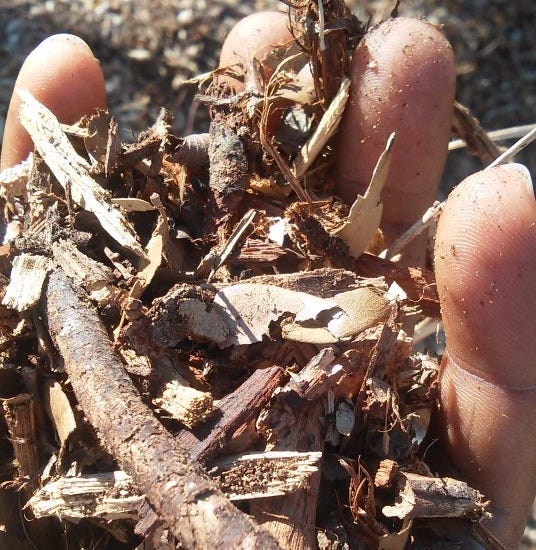
So that morning, I stopped by to take a closer look at it — the mulch. It looked like trash, and it was, and it isn’t.
......
Henry Ford & Crude Oil
Who started Kingsford Charcoal, the company? Till I read the book Rework by Jason Fried & David Heinemieier Hannssson, I didn’t know. But it’s interesting to find out that Henry Ford did.And the backstory is worth paying attention to. Here’s a clip:
Henry Ford learned of a process for turning wood scraps from the production of Model T’s into charcoal briquets. He built a charcoal plant and Ford Charcoal was created (later renamed Kingsford Charcoal). Today, Kingsford is still the leading manufacturer of charcoal in America — Rework
On the back of this is another interesting thing I read about in an article sometime back. It’s about the number of by-products that can be had from crude oil, which is what petroleum is. The number was in the thousands.
Enter Wikipedia:
Over 6,000 items are made from petroleum waste by-products including: Fertilizer, Linoleum, Perfume, Insecticide, Petroleum Jelly, Soap, Vitamin Capsules. See link to partial list of 144 by-products listed by Ranken Energy [3]
Worth pondering over, right?
.......
Gladiator
Recently a friend of mine who loves movies recently bought a DVD of a movie he loves and considers a classic.I mean this guy loves movies, the suspense, drama, and the layers of storytelling that goes on in movies, he will spend hours telling you all about it, making clear what may not be apparent to you. He lights up.
So when he bought the extended version of the movie Gladiator with Russell Crowe I was not surprised. The DVD was a little heavy and packed.
This edition came with more features, deleted scenes, how characters were created, sound and visual effects, costume design galleries, cast portrait photo galleries, storyboard demonstrations, tales of the scribes, story development, the tools of war, and more. And all this was broken down into a 3 Disc pack.
Here’s the 3 Disc’s contents ( let me just share a few of the contents from each of them):
- Disc 3:
Supplementary: Storyboards, Production design and galleries, Ridley
Scott’s own sketches of “Maximus’ Journey” Costume design
galleries, visual effects, abandoned sequences…
......
You Can’t Make Just One Thing
One of the most finest lines I have heard about the creative process again comes from the book Rework. Here it is:When you make something, you always make something else. You can’t make just one-thing. Everything has a by-product. Observant and creative minds spot these by-products and see opportunities.Henry Ford saw his, crude oil producers see theirs, and movie-makers see theirs. What about you and I?
......
You
& Me.
Day in and day out we wake to get things done, and whether we like it or not our lives are in the making. We are creating something. We are picking up things, including little pieces of information.
If you’ve lived here on earth past a quarter century, you have picked up something worthy along your journey. What have you learned? What interesting experiences have you had? What unique insights do you have? How is that useful to someone else? Is that value?
But more importantly can you offer it to someone else?
But if you offer it in a jumbled order, it’s of no value to anyone. It must be geared, organized, and directed towards solving a specific problem for someone else.
What you have are pieces of problem solving bits, and they are not useless. You only have to re-purpose them towards something specific that makes a difference for someone.
Mulch in it’s basic components is little pieces of wood scraps, broken tree limbs, and a lot of ‘obviously’ useless bits. But when organised and packaged for the sole purpose of enriching garden soil, suddenly it’s a product, and it’s valuable.
Do you see your by-product?
Also, I apply the by-product principle in the offering of my new book, Get To Know Your Backyard Opportunity here. And feel free to let me know your thoughts, too, or share it with someone who will find it useful, if it’s not for you. Thanks.
