purpose

(For every page's details, please scroll down.)

I am Kingston, and this is my project page.

This site is to document my journey through projects to help individuals and small business owners with a couple things that could make a difference.

I do this via mini projects. I also write, and I recently released my eBook ( Get To Know Your Backyard Opportunity), based on the lessons from my 21-Day project here in Austin, TX.

This book is aimed at highlighting the initiative we can all take to gather valuable skills in writing, communication, and interacting with people through an interview project in our local communities. The benefits could be life-changing.

Update Note: In the meantime, you can also pick up a free copy of my released mini-guide: Start With A Story: A Mini Guide On Opening Your Book With A Tale.

And also check out my latest startup in NYC, Kilimanjaro.

spacer 2


Monday, December 28, 2015

What Do You See?

As a boy, I was making my way through Steve Covey’s book, 7 Habit Of Highly Effective People, when I came across this photo.

I looked at it for a while and tried to see the young lady. It took me a while, but eventually I saw her. Do you see her?


Wow, what a paradigm shift! This way of looking at things has stayed with me into adulthood, and I try it out on many things.

You know how when you move to a new neighborhood you see the whole place in one way, and then after a year or two, it looks familiar and different? But if you stop long enough, probably on a leisure walk and think back to the way the environment looked when you first moved there, you can still see the old perspective — that’s a paradigm shift, too.

As someone once said, nothing is ever as if first appears. There 2 ladies in the photo above. The old lady looks haggard, worn, and gloomy— not a positive outlook and her countenance is down-ward.

But simply shift perspective and you see the pretty young young woman, her finely defined jaws, and her hopeful outlook into the future. All it took is a simple shift!


As the year comes to a close, take time and look back on the past year and see what has changed in your life. How are you different from when the year started? Do you see things differently? Is your perspective positive? If not, what can you do about it?

Surely, I hope you don’t look at your life and see no positives. They are always there, waiting for your recognition. They are there. You even have a story to tell from your experiences from 2015 alone. You picked up lessons, whether you had a hard time of it, or things worked out perfectly.

Yet, if you are still struggling to see it, it’s a good time, this time of the year, to take some alone time and wipe your perspective clean. Are negative emotions blurring your ability to see the positive? Are some unpleasant experiences getting too much space in your heart and mind? All these have no power over you.
Just as you would take a wipe and wipe off foggy glasses, so can negativity be wiped off with a good dose of light and positive truth. Also, if you need to, pray — for with God nothing is impossible.
Here’s to a great year in 2016! Keep God in the first place, trust in Jesus, and lean on the holy Spirit.

And at all times keep the right perspective, and no matter what happens, know you can always shift your perspective, get hold of a positive paradigm, and turn things around.

In the end, nothing, absolutely nothing, is useless if seen or positioned right.

All the best!

Friday, December 25, 2015

Merry Christmas!

On this day of our Lord and savior Jesus Christ, I'd love to say a very merry Christmas to everyone---business owners, customers, and all partners.

Thanks a lot for everything!

---Kingston.

Friday, December 18, 2015

How To Give More As A Writer

Okay, so you are done writing your book, you are excited (maybe nervous at the same time) and wondering what the whole world will think of your book.
These nerves are normal. It happens whenever you are about to do something significant. Change is about to happen. Take heart, you will live.

And once the dust settles you will be the better for it. If it doesn’t go well, you have taken a courageous step, and you now know what doesn’t work, and can adjust for next time — also your faith and mind have expanded to a greater degree, and they will not go back to their former sizes. Most people will never experience that. If it goes well, you know what happens, right? Congrats!

Or, you may be thinking of writing a book. Yes, it’s possible, and you can do it. How do you build a skyscraper? You know the answer.

Okay, so lately as I launched my new book, Get To Know Your Backyard Opportunity, I decided not to offer it by itself, as a standalone product. The way traditional book publishing has always done it. I think this new way offers more value to readers, and to writers, too. It’s a win-win.


Gladiator

Recently a friend of mine who loves movies bought a DVD version of a movie he loves and considers a classic.

I mean this guy loves movies, the suspense, drama, and the layers of storytelling that goes on in movies. He will spend hours telling you all about it, making clear what may not be apparent to you. He lights up when he’s at it.

So when he bought the extended version of the movie Gladiator with Russell Crowe, I was not surprised. The DVD was a little heavy and packed.


The Publishing House & Unmet Needs

Okay, let’s take a quick look at the way the publishing house goes about the book publishing process ( at least from the way I see it; I don’t know much about the whole industry, though). From what I know, the publishing house takes the book, they polish it, and get it out there for you, and that’s it — -you share in the revenue, and the deal is over ( at least for now).

But a closer look at the times will reveal a change most may not see. Yes, the times are different, and wisdom is to adjust to match it. The power is no longer in the hands of publishers; not like it used to in the past. With the tools we have now — ebook readers, editing softwares, blogs, and personal websites — and a closer relationship with the ultimate consumer of our products, the terms of offer could be different, if we self-publish.

But having said that, let me focus on the consumer for a few minutes. The old fact about the consumer has not changed — he still loves to read, and to read about things that bring him pleasure or things that help him solve a problem. But something else is still the same — his needs are still far more than just reading for pleasure or problem solving.

But a few decades ago, these needs went unmet. He had the need, but he resigned himself to what the writer offered him — or what the publishing house offered him. Yet, in the end, the consumer is the king, right? Do what’s right by the king, and you are in business.


The Now & You

Let’s look at a quick example: A reader who buys a fiction book, enjoys the book, and recommends it. Yet, more likely than not, that reader is a writer, too, right? How? 

Definitely, it’s not a stretch to say that the chain between reading and writing is not that long — I love to write because I love to read great reads, and now I want to give back by sharing what I know, too. That’s why I write.

In that same way, most readers are writers too, and as a natural consequence, would love to grow in that capacity. The question, then, is this: can you the writer help them do this?
How? In the creation of your book, the only value is not just what you know or what you created. Another value is the process you went through to create it all. That’s value in it’s own right. Is that useful to a young writer?
If I had a young writer sit next to me while I went about creating my table of contents, themes, characters (If I’m writing fiction), writing it all out, editing, and packaging the whole product, and afterward give him a copy of the book, will he only have the copy of the book?

No. He not only has a copy of the book, but a copy of how I went about everything I did — in his head. He now knows it, he owns, and it’s his. If pressed, he can spell it out (from his viewpoint). For a young reader of my book who loves to write and maybe wondering how this whole thing was put together, could my creation process be value to him? You know the answer.


Multiple Packages

Now in our day, if we have the power to rework the terms of the offer, why not offer something that benefits both sides? Why not offer a lot more value to the reader?
Since the buyer can come directly to you, why not say this: “Hi, I know you’d like the book, but here’s a lot more for you from my creative process. I will offer the book in packages with a lot more in them for you. Yet, surely, I have the book by itself (as a standalone) for you, too, if you prefer.”
It’s a conversation with the ultimate consumer of your product, for now there are no middlemen to dictate the terms.

This is the ground upon which you the writer can offer a lot more to your reader by way of multiple packages, 2 or 3. And the underlying reasoning behind all this is that your readers come to you with different needs, and by only offering your book by itself, you are denying them the opportunity to choose what works for them based on their needs.

But also, could some of my readers not care about the added value? Yes. And for them, is the standalone product still available? Yes.

To make it a little more clear, consider this.

What if in addition to your book (if you write a fiction book) you add a guide or short read on how you created all the characters, what their backstories are, why they are ‘alive’ and vivid in the book, and why you positioned each of them as you did?

Why not go behind the scenes with another add-on product that shows that process? Also, will some of your fans prefer an audio version of your book? I’m sure. That’s where the audio book comes in. Some still may simply want to hear your voice as you describe your experience, and share what you know. That’s where the audio commentary comes in, another feature.

You can take all these and create packages out of them. For example, the book alone, as the basic version; the book plus the audiobook and an short guide on how you created everything, the middle package; and a total package, which includes the book, the audio book, more training in the form of a guide, commentary, and breakdown notes on your character creation.

There you have it: 3 packages, and the standalone product is still available.
In essence, you let your readers choose what works for their needs, and you do not deny anyone either. Value in the end is just your ability to make your readers feel a lot better about themselves or help them solve a problem, and all of these desires come in degrees. Multiple packages addresses them in the best possible way.


My Friend & His Movie

Back to my buddy who bought the DVD, for you’ll see this idea even in the movie industry, and you know those guys know what they are doing.

The movie edition he bought came with more features, deleted scenes, how characters were created, sound and visual effects, costume design galleries, cast portrait photo galleries, storyboard demonstrations, tales of the scribes, story development, the tools of war, and more. And all this was broken down into a 3 Disc pack.

My buddy sits and studies the movie thoroughly, going through all the various add-ons that came with this edition of the movie. He picks up lessons and sharpens his understanding of how all this works, the movie-making process.

Here’s the 3 Disc’s contents ( let me just share a few of the contents from each of them):
  1. Disc 1: Feature: All new commentary by Ridley Scott and Russell Crowe, Trivia Deck, etc.

  2. Disc 2: Documentary: “Strength and Honor: Creating the World Of Gladiator” Never before seen seven part Documentary: The glory of Rome, Shadows & Dust, Tale of the scribes, The heat of Battle, and more.

  3. Disc 3: Supplementary: Storyboards, Production design and galleries, Ridley Scott’s own sketches of “Maximus’ Journey” Costume design galleries, visual effects, abandoned sequences…
But is the movie by itself still available? Yes.

Even in software subscription online, we see this offer in terms of tiered pricing. 

Often, it’s the free version, the basic, the premium, and something else. Why? They know we all have different needs, and they will try their best to meet all of that. It’s a win-win. We get what we want, and they do not deny anyone.


Now What?

So if you are still working on your book, think of your creative process as value in it’s own right. If you already wrote your book, think of offering more to your readers when you do the update.

And yes, this means a lot more work for you to create these add-ons, but look on the bright side, it’s work you do one-time, and then you get to offer it forever. All the best.


Special note: A lot of thanks to Nathan Barry, from whom I first saw this idea.


Friday, December 11, 2015

Turn Your Project Into A Book ( A Free Sample)

A sample out of the add-on guide (Turn Your Project Into A Book) that came with the book, Get To Know Your Backyard Opportunity.


Introduction

Share the juice
...................

Okay, let’s get straight to the point. You are done with your project, or are thinking of starting one. Projects abound and for different purposes. Every project is with a defined goal and time frame. Whatever the purpose, save for a few classified exceptions, the lessons of every project should not stay with the individual or group who undertook the gig. Out there, there are folks who will find the lessons useful, and the story should get to them. Someone’s whole life could be turned around with a single line of counsel from your project. So let’s share the juice.


Personally, I love projects for their ‘seasonal’ nature — you start them, create something out of it (value), and then sit back and consider what the next one will be. That opportunity it provides to finish and take a breather is crucial, and I value it greatly. Why? Even God himself rested a bit after His work, and also designed days to have nights when we all turn in for a rest and wake to a new day.


Projects are like days — we finish them, rest up, and wake up to a new or related one, with renewed energy, focus, and with time taken to collect the lessons of the past one and apply them to the upcoming one. I like this breather, this time to pause, for I am not one for the forever project — the one without an end, draining you of all creativity, and leaving no room for reflection.
..................................


My Story

So in this guide, I share the lessons I came away with as I sat to package the contents of my personal project, a 21-day local interview project of small business owners in my local community of Austin, Texas.


Towards the end of last year, I was in the middle of a difficult time, working a job I didn’t like. It took a toll on me and made me think long and hard about how to create a change. I sat down and collected my thoughts on what I liked, loved, and could do, and put it all together. Out of this gathering, I created a 21-Day project of venturing out there to see how I could be useful to others in my local community, small business owners, to be precise.


After a few considerations, I decided to simply have conversations with them. Initially, I was hoping it could turn into some sort of side gig where I will be able to solve a few problems for small business owners, but I decided to hear their stories instead, sort of a long-term thinking approach. I chose to create relationships instead of a one and done deal, or a touch and go thing.


This led to a number of interviews with some of the finest small businesses in the city of Austin, Texas. Also, I came away with and gained greater insight into some essential skills in blogging, writing, communication skills, and dealing with people in general.


After the project, I realized what a useful project it is to challenge myself and step into the unknown while using my skills at the same time. In that spirit, I decided to share the lessons with others in a book.


Why? This happened in my local community, and realizing there are local communities everywhere, the opportunity for others to do something similar is all over, I decided to package it all into an actionable guide/book that shares my story and teaches others at the same time.
.......................................

Recognizing Value


This is when I started packaging my project into a book, or turned it into a book. And having gone through the process, I know projects abound, with each having its unique lessons. But for lack of packaging or an inability to turn them into a single source product, their lessons vanish or end up staying with only those who were involved in the project or the single individual who did it. There’s a way to overcome that.


First thing to think about is this: The earth is full of value, or things that are useful. Whatever good thing that you set out to do, it always leads you to take on challenges, and in taking on challenges, you figure out how to do something that probably has never been done before, has been done by a few people, or has never been done the way you did it, or intend to do it. That’s value.
So how you see something, and how you do it, how it helps you solve a problem, and how well you solve it are all unique forms of value. Value in the end is perspective.
..................................


How Do You Eat An Elephant?


I know, I know, the value conversion process is not always easy. Questions like “Where do I start?”, “What do I say?”, “How do I know I have lessons?”, “How do I arrange it all?”, “How I do I know it’s even useful to someone else?”, and others can stop you entirely from even attempting. But take heart, even an elephant can be eaten, entirely, and that’s what book-writing can be sometimes, a giant amorphous task.


But like all things, they are never as bad as they first appear. With thought, planning, and a one thing at a time approach, you’ll see it all coming together. Do the first thing, the second, the third, and then the fourth, and on and on, and you’ll see your courage growing to match the task. And with a rise in courage, an elephant could soon become a fly. But you have to start first.


For example, let’s say you are done with your project, and want to package it all, and you sit down to start. You could start with the end in mind: The book. Okay, with that let’s start with the first thing you did to work on your project. Write that down. How did you end it, or what did you achieve? Write it down. What was your goal, what happened during the project to get you there, and what did you learn? Write those down, too.


With those 3 you have the basic pieces of any journey: A beginning, what happened along the journey, and how you got to your destination. Same way with a book — an introduction, a body, and a conclusion. These are the same 3 things in life itself — birth, life’s work, and value created, or the impact you had. The great 3.
Now, with this start, the elephant is now laid out on a table, the butchers table, and ready to be sliced into various pieces. These very pieces are what we are going to eat one bite at a time to finish this ‘elephant’ and give birth to the book. Now, we have perspective, right? Good.


As the saying goes, “Nothing in life is to be feared, it is only to be understood. Now is the time to understand more, so that we may fear less.” — Marie Curie.


Now, what’s a book, really? Okay, a book is a written material that contains chapters that express thoughts on different things or recounts an experience, fiction or non-fiction. Now, what are chapters? You probably know chapters are most simply one, two, or three short essays that breakdown an idea. So they are short essays, right? Okay, what, then, are essays if not short 3, 4, 5, or 6 paragraphs that make a point or flesh out an idea? And on and on, till you realize that it all starts with a single letter, an a, b, c…


This is what writing is, at heart. A few letters become a word; words are strung together to make a single statement. A group of sentences are put together to become a paragraph, expressing more on an idea. Like this one you are reading. And then paragraphs become essays, and then chapters. And the book is on the way.


How do you build a skyscraper, if not a brick at a time?


(Note: This is not to belittle the art of writing, but I write it with the understanding that anyone who has finished a worthwhile project or thinking of starting one has a decent writing ability, or a fair understanding of what makes up a book.)
......................................


Nothing To The Grave


Yet, some may to me, “No, Kingston, I can’t write. I don’t even like it. It’s too difficult.” Or, “I don’t think I have the patience nor the time.” Or, “I cant sit and comb my mind to bring up value or lessons, nor document my journey while my project is ongoing.” Yet others may say, “I am just a verbal guy, I am good with saying it, or just speaking.” Okay, okay. What I say to you is this: Does that mean the value of your project dies with you, or your lessons go to the grave?


No, no. As a minimum, have you seen those books that are written by the author and someone else? No, not the one that both authors wrote together, like co-writers. But the one that says, ‘By Mary Beth with John Grisham’ — meaning Mary Beth worked with or hired John Grisham to put the whole thing into written words. Yeah, that one, and I bring that up to mean that even if you can’t write, someone else can help you do it.


There you go: There’s almost a way around the mountain, and the value of your project should live on.


The Benefits?


Okay, before we go on, let’s put the carrot ahead of us. Let’s flesh out why it’s even beneficial to turn your project into a book. What’s the benefit of writing a book? Let's take a look at the following
................ 

For The Store

One, a book is your own personal way of storing your story. You did something worthwhile, that you enjoyed, and challenged you. That must be saved. If for nothing at all, for review and a way to measure your progress. Review? Yeah, how can you build on something that’s not clear? It’s difficult to do that if the only place the story is stored is in your mind, foggily. A book makes things clear and puts it in a ‘safe’ for later.


Also, for personal reasons, it’s good for that nostalgic feeling we all have when we look through our personal journal or diaries after a few years and realize how far we have come or have grown. That look-back often leaves most people with tears, and surely that good smile and head shake that says how thankful we are for what we did, went through, what we overcame.


Sure, a book is not a diary, but the day may come when you may sit and pick up your own book a few years later and see what you wrote.


Listen to President Barack Obama, many years after the publication of his first book, Dreams From My Father. (His political leanings do not a matter here, just his humanity and the point of what he says.)


For the first time in many years, I’ve pulled out a copy and read a few chapters to see how much my voice has changed over time. I confess to wincing every so often at a poorly chosen word, a mangled sentence, an expression of emotion…”
We all have those look-backs from time to time, and instead of a foggy mind to do it with, a book is a clear and sure way to see what has changed or how far we have come.


Also, if your book is published and distributed, there’s no way it will be lost — even if a storm comes through your town, pulls up trees, washes away homes, takes people’s belongings with it, and damages your one and only personal manuscript, your book will still be in existence.


Give To Others

It’s usually $3.97, $5.99, or $12.00, the price of a book. But when you pick up a good book, more often than not, the value you get out of the book far outweighs what you pay for it. That’s if you see the value and can apply it in some way in your own life.
Critically looking at the trade-off, you are actually giving to readers, if you write a good book. What may have taken you more time and money to make, considering everything you went through and learned, you give away at a fraction of the cost, if you strive to write it well and load with value. This is great value to your reader.
Price is what you pay. Value is what you get — Warren Buffet.
So if your book’s value exceeds the price by giving in content more than the cost of the book, it’s a giveaway. And as we all know, it’s far better to give than to receive.


Your Book Will Go Where You Cannot


Okay, let’s talk a little bit about who we are as human beings and our situation. We all have have limited resources and ability. We cannot be everywhere at the same time, and do not have unlimited powers.


Yet, we all have something to say, but have limited hours in a day, and can only speak for so long. This is where a book comes in — it can speak and go where you cannot, it takes over and carries your message long after you are no longer able.


Let’s take Warren Buffet’s case, for example. In his twenties, Warren Buffet picked up a book — The Intelligent Investor — on value investing written by Benjamin Graham. Warren loved the book so much that in his decision to go to grad school he chose Columbia University after finding out that Ben Graham, the author, was a professor there. Through a series of conversations, Warren later ended up working for Ben Graham on Wall Street, and that led to one of Warren’s Buffet’s most influential and treasured relationships in business and life.


The principles of value investing in that book is largely responsible for the making of one of the smartest investors on earth now. But for sure, when Ben Graham sat to write his book, he wasn’t thinking about Warren Buffett, nor did he even know he existed. But the book went all the way to Omaha, Nebraska to Warren.
Remember readers are learners, and learners who apply what they learn are leaders. Putting a book out there gives you a chance to connect with some of the finest people out there, and could even lead to key partnerships, even friendships like we see in Warren Buffett’s case.


How can two walk together unless they agree? (Amos 3:3) Show who you are in your book and the right people will connect to you.


Opens Doors


Yes, you are writing your book to share your knowledge and discoveries with the world. But you know what? The book being out there is actually a living and breathing resume, or portfolio, for you. Problems are opportunities, and many people out there are always looking for problem solvers. But to find a problem solver, there’s a “get to know” process, a time to find the right person. This is what we all know as the interview process.


Yet the interview is a way of dealing with or getting rid of uncertainty, a way to find out more about the ones we want to hire. But then again, what’s fear, doubt, or uncertainty’s great nemesis? Knowledge. And your book is a your way of sharing your knowledge.


Also while an interview may be a good way to present your abilities, it’s too strict and formal a process that may not reveal much about who you really are. Neither can a written resume, which has space for only a few things, and is often only one page or two.


Also, folks looking to hire are, above all, interested in your thinking process, how you approach problems, how you present things, and your communication skills. And writing a book on your project shows all that without you having to say a word. It’s all there in the book as a living resume (if it's a topic connected to the job you want.)


A good example is the story of the author of the App Design Handbook, Nathan Barry. Listen to Nathan himself:


When I still did consulting work I was on a call with two people from a company that was deciding whether or not to hire me to design their new iPhone app. This was just after my book, The App Design Handbook, had been released and the junior person on the call had read my book and loved it.


The manager wasn’t so sure about hiring me. If my design was so good, why wasn’t I working in the Bay Area?


I listened to the two of them go back and forth for a minute before the manager relented and said, “Actually, of course he’s good enough, he wrote the book on the topic.”
How would you feel if you could say you “wrote the book on the topic”? Do you think that would help your career?” — Nathan Barry
There you have it. There’s a reason why the word ‘author’ is closely related to ‘authority.’


It’s Your Way of Collecting Your By-Product


Why should it go to waste? When I say that, I mean the lessons of your project. Plus, it could possibly be another stream of income.


One of the finest lines I have read about the process of creating is out of the book ‘Rework’ by the founders of the company Basecamp, formerly 37 Signals, Jason Fried & David Heinemeier Hansson:


When you make something, you always make something else. You can’t just make one thing. Everything has a by-product.” — Jason Fried & David Heinemeier Hannsson, Authors Of Rework


In that book, the section on by-products shares the story of how two of their books came into being: Here it is, in quote:


Our last book, Getting Real, was a by-product. We wrote that book without even knowing it. The experience that came from building a company and building software was the waste from actually doing the work. We swept up that knowledge first into blog posts, then into a workshop series, then into a PDF, and then into a paperback....The book you are reading right now (that’s Rework) is a by-product too.” Rework, page 90.


There, is how you turn your experience into a book. You may say to me, “Kingston, I see what you mean, but I don’t have a company, neither have I built software.” Well, you’re right, but did you just complete a personal project that could be useful to someone else, to a person who is just starting out?


In principle, your project and building software are the same. You may not have a grand app, but at your level, which may be lower, you still created something of value through your project. Why not share the story and teach others through a book?


Or, you may be thinking of starting a project that could help other people. Why not save the lessons in a book for others? And this is why I stress the importance of blogging your project the entire time when you are at it? It’s easier that way to collect the experience later for packaging, even if for your own personal report or review.


Even in the great book, the Bible, it says a similar thing about how we should roast what we took in hunting. A project is a hunt, not unlike the ancient hunting we all read about. In principle, it’s the same. It’s a dare, a reaching out, an outgoing to gain what we don’t currently have. (The word ‘project’ itself is made up of two words — ‘pro’ meaning ‘for’ and ‘ject’ mean ‘to reach out, or go out’, as we see in the word ‘eject’. )


With that comes a by-product. It’s wise, then, to ‘roast’ that by-product by turning it into something valuable. Here’s the verse:


The slothful doth not roast what he took in hunting. But the substance of the diligent is precious — Proverbs 12: 27
Whatever we do has a by-product. Let’s save it.
...............................

 End Of Sample

If you enjoyed this sample, and are thinking of working on a personal project or have already completed with lessons worth sharing, consider sharing it through a book. The full guide takes you into the nuts and bolts of how it all comes together into a book

You can take take a look at the table of contents here. It also comes with a workbook to help you gather  the contents of your project and organize it all before you start writing. This makes the writing process a whole lot easier.

Get the whole deal! 

Monday, November 30, 2015

Why You Should Pay Attention To Your By-Products

Recently I took a walk through my neighborhood after going out for a morning run. After the run, I decided to take a longer route back to the apartment. I often do this to challenge my mind to be accepting of new things, and to break routine.

But taking the different route led me to the neighborhood garden. This year my neighborhood got a new garden that we’ve all come to appreciate very much. From what I hear, it all came about after one lady decided to request the previously unused plot of land from the City of Austin and make a garden of it. How the back and forth went, I don’t know, but when the city gave permission and folks broke ground, I enlisted to volunteer to help get it in shape and create beds for the garden. We got it done, fenced and all.

So it’s all a pleasant morning stroll, or at anytime of the day, when I walk by and see the transformation, as my mind goes back to what it used to be like — nothing like what I see now. Members of the community have bought beds and are growing all kinds of plants, flowers, vegetables, and the like, there.
But with gardening comes things to buy, right? That’s how mulch found it’s way to the garden. A huge pile of it is set aside right next to the garden for use.

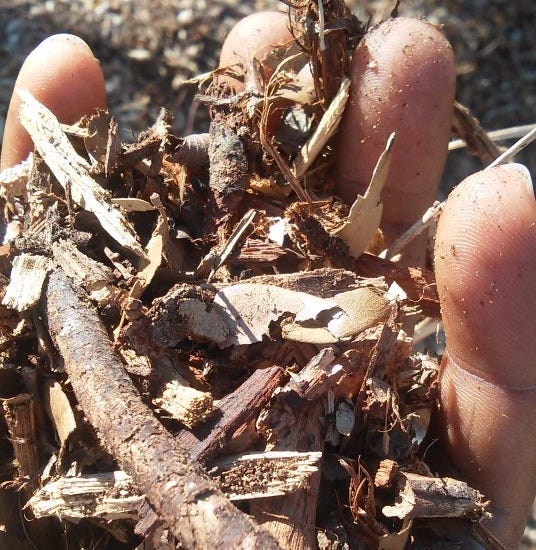
So that morning, I stopped by to take a closer look at it — the mulch. It looked like trash, and it was, and it isn’t.


I scooped a bit into my hand and took a close looked at what it’s basic ingredient is — pieces of leaves, wood scraps, little tree limbs, and all. Not much of value. Or?
......


Henry Ford & Crude Oil

Who started Kingsford Charcoal, the company? Till I read the book Rework by Jason Fried & David Heinemieier Hannssson, I didn’t know. But it’s interesting to find out that Henry Ford did.

And the backstory is worth paying attention to. Here’s a clip:

Henry Ford learned of a process for turning wood scraps from the production of Model T’s into charcoal briquets. He built a charcoal plant and Ford Charcoal was created (later renamed Kingsford Charcoal). Today, Kingsford is still the leading manufacturer of charcoal in America — Rework

On the back of this is another interesting thing I read about in an article sometime back. It’s about the number of by-products that can be had from crude oil, which is what petroleum is. The number was in the thousands.

Enter Wikipedia:

Over 6,000 items are made from petroleum waste by-products including: Fertilizer, Linoleum, Perfume, Insecticide, Petroleum Jelly, Soap, Vitamin Capsules. See link to partial list of 144 by-products listed by Ranken Energy [3]
Worth pondering over, right?
.......


Gladiator

Recently a friend of mine who loves movies recently bought a DVD of a movie he loves and considers a classic.
I mean this guy loves movies, the suspense, drama, and the layers of storytelling that goes on in movies, he will spend hours telling you all about it, making clear what may not be apparent to you. He lights up.

So when he bought the extended version of the movie Gladiator with Russell Crowe I was not surprised. The DVD was a little heavy and packed.

This edition came with more features, deleted scenes, how characters were created, sound and visual effects, costume design galleries, cast portrait photo galleries, storyboard demonstrations, tales of the scribes, story development, the tools of war, and more. And all this was broken down into a 3 Disc pack.

Here’s the 3 Disc’s contents ( let me just share a few of the contents from each of them):
  1. Disc 1: Feature: All new commentary by Ridley Scott and Russell Crowe, Trivia Deck, etc.
  2. Disc 2: Documentary: “Strength and Honor: Creating the World Of Gladiator” Never before seen seven part Documentary: The glory of Rome, Shadows & Dust, Tale of the scribes, The heat of Battle, and others.
  3. Disc 3: Supplementary: Storyboards, Production design and galleries, Ridley Scott’s own sketches of “Maximus’ Journey” Costume design galleries, visual effects, abandoned sequences…
Definitely these are all by-products from the making of the movie, right? And definitely they did not go to waste. My friend found saw value there and bought it. He saw how it could help him improve his understanding of the movie-making process.
......


You Can’t Make Just One Thing

One of the most finest lines I have heard about the creative process again comes from the book Rework. Here it is:
When you make something, you always make something else. You can’t make just one-thing. Everything has a by-product. Observant and creative minds spot these by-products and see opportunities.
Henry Ford saw his, crude oil producers see theirs, and movie-makers see theirs. What about you and I?
......


You & Me.
 
Day in and day out we wake to get things done, and whether we like it or not our lives are in the making. We are creating something. We are picking up things, including little pieces of information.

If you’ve lived here on earth past a quarter century, you have picked up something worthy along your journey. What have you learned? What interesting experiences have you had? What unique insights do you have? How is that useful to someone else? Is that value?

But more importantly can you offer it to someone else?

Nothing is useless if positioned right.
But if you offer it in a jumbled order, it’s of no value to anyone. It must be geared, organized, and directed towards solving a specific problem for someone else.

What you have are pieces of problem solving bits, and they are not useless. You only have to re-purpose them towards something specific that makes a difference for someone.

Mulch in it’s basic components is little pieces of wood scraps, broken tree limbs, and a lot of ‘obviously’ useless bits. But when organised and packaged for the sole purpose of enriching garden soil, suddenly it’s a product, and it’s valuable.

Do you see your by-product?


Also, I apply the by-product principle in the offering of my new book, Get To Know Your Backyard Opportunity here. And feel free to let me know your thoughts, too, or share it with someone who will find it useful, if it’s not for you. Thanks.


Friday, November 20, 2015

Walking Into The Unknown

This is an excerpt out of recently released eBook, Get To Know Your Backyard Opportunity.


Walking Into The Unknown

It’s like a voyage of discovery into unknown lands, seeking not for new territory but for new knowledge. It should appeal to those with a good sense of adventure — Frederick Sanger.
.....................................


My approach is to go one street at a time. Keep in mind I didn’t know anyone — -business owners, that is — -personally. So I go out and take my chances. But it’s not just me and the chances. It’s me and some goodies in my pocket — the desire to learn, a clear idea of what I’m out to do, the purpose of my project, going about things in a professional manner, goodwill, a desire to write all about it and share the stories I collect, and a clear idea of how to present my project and set up interview appointments. And all of it for free. And lest I forget, joy and a smile. These are trump cards on their own, it’s only up to me to use them well.


Okay, so when I’m out, already knowing about the locality pretty well, I pick one street and go from shop to shop presenting my project to owners.


I was turned down by some, and also run into shops where the owner was absent, but for the most part it went well. For stopping by about 10 shops in one stretch, I will come away with one interview. And if you factor in absent owners and having no prior relationships to tap into, I’d take one interview any day.


Also, besides the tools in my pocket, I also have at heart that in the end these business owners and I are the same at heart. We all want to be loved, to belong, to be acknowledged, and to be part of something good. In this case, I have created this good thing that I know they ( if they get to know my reasons) will definitely want to be a part of. As of writing this book, some of them were the very ones who gave me testimonials to share on my book page, after getting to know me through the project, and a good amount of them are now my Facebook friends.


Also when I’m out prospecting like this, I’m only out there for about 2–3 hours, sometimes 1, at a time. Sometimes I visit only 5 shops in a day. You can see how I spent my day in the behind the scenes posts that I wrote about towards the end of the book, in the later chapters. There, I share everything I wrote about on a daily basis while the project was going on.


In the same way, I’m sure you know your local community very well, so pick a few streets that you will be visiting business owners on during your project. Yet if you already know a few business owners, do your first interviews with them and use that as evidence when you are ready to go out and talk to owners you don’t know.


But after picking a street, simply walk in, like I share above, and present your project. With your presentation in mind, and believe me you’ll come away with interviews.


Again, know you have these in your pocket.
  1. Sincerity
  2. Goodwill
  3. Desire to learn
  4. Desire to write about it
  5. Willingness to share their story with others
  6. It’s all free and costs them nothing save a few minutes of their time
  7. A smile.


Do this for 7 days, 2 hours a day, and you’ll come away with 3–4 interviews, at least.
This is for folks who will like to do my kind of project ( with business owners). But for those looking to interview another kind of professionals, a similar approach will work. For, let’s say churches, if you want to interview pastors, it will be visiting a select number of churches in your local community and requesting to meet the pastors. The same list above applies in approaching them, too.


For folks focusing exclusively on interviewing chefs, it will be visiting only restaurants and requesting to talk to their chefs. For teachers, it will be local schools, for stockbrokers, it will be visiting investment firms in your neighborhood, however few there are there, and so on. You get the idea. But the goodies I list above work in almost any situation.


What will I get from all this?


Okay, what will you get from 'walking into the unknown'? The opportunity to step outside your comfort zone is something you should always consider carefully without turning it down immediately, for out of those come some of the best of all a person's personal growth.


Why? The opportunity to step into an unfamiliar zone, where you know no one, or a few people, to share an idea, or to complete a project will draw on the best inside you.


In this case, you’ll be dealing with people you don’t know, but you get out there and engage with them. This is like standing in front of a small section of the world and doing a presentation on why you should be heard. This is not a grand public presentation, but an opportunity to start there, and start working on your presentation skills, and people skills.


The whole world revolves around people, and people are the essence of the world. Some may say animals matter, too. Yeah, they do, but only in the sense that we human beings value them, or their existence helps us. So in the end, an ability to deal with people is one of the greatest skills to have an opportunity to learn.


You have lived in your local community your whole life and may privately hold a desire to travel overseas as a chance to grow and expand your understanding of the world and of yourself. A great desire, I would say, but the reason most people who travel overseas and come back with a new-found self-understanding is the unfamiliarity that being abroad or living in an unfamiliar environment forces you to wrestle with.


It’s like taking the baby bike-supports off your child’s bike and asking him to ride on his own. In that moment, he has nothing to hold on to, but to draw on something inside him, to trust that he can do this. And the capacity that is already inside him but lies untapped will come forth. That’s what foreign lands do to you. They bring out the fears first, and then the treasures deep within.


Well, foreign lands are not always physical. They are mental too. If someone says “I have never done this before,” they only mean that whatever they are talking about is foreign to them, their mind has never experienced something like that. We see this with public speaking. People who are new to it have to deal with stage fright because to their minds this is foreign territory.


So is a local interview project. It forces you to interact with your local community in a new, ‘foreign’ way, and that will test you. But in a good way. It will draw things out of you that you never knew you had. You’ll see your local community in a new light, and when you are done, you’ll have expanded your being, and your relationships, too.


So if the money to travel nor the opportunity do so through a group does not present itself, create your own “foreign” at home, create your own “unknown” right where you are with a local project, and go out and execute.
............................

If you enjoyed the read, you'll love the whole book: Get To Know Your Backyard Opportunity


You will get nothing useless from me. Be assured.

Get The Nuggets From My Projects

* indicates required