purpose

(For every page's details, please scroll down.)

I am Kingston, and this is my project page.

This site is to document my journey through projects to help individuals and small business owners with a couple things that could make a difference.

I do this via mini projects. I also write, and I recently released my eBook ( Get To Know Your Backyard Opportunity), based on the lessons from my 21-Day project here in Austin, TX.

This book is aimed at highlighting the initiative we can all take to gather valuable skills in writing, communication, and interacting with people through an interview project in our local communities. The benefits could be life-changing.

Update Note: In the meantime, you can also pick up a free copy of my released mini-guide: Start With A Story: A Mini Guide On Opening Your Book With A Tale.

And also check out my latest startup in NYC, Kilimanjaro.

spacer 2


Monday, January 25, 2016

An Easier Way To Gain People Skills

We all need skills. Nothing worthwhile is possible without them.

And one of the best is people skills. Technology cannot touch that.

Without much labor on this point, people skills are important. The whole thing starts and ends with people, you know. So gaining a good handle on how to deal with people is key to a whole lot.

How, then, can you start working on yours, if you feel unsure when interacting with people? How can you get comfortable having meaningful conversations with others?

A simple conversation where you set out to learn is all it takes. Interview others as a way of learning from them, and get the by-product that comes with it: experience and a relationship.
Here’s an easy way to get started.

Take out your smartphone, and look for the voice recorder that came with it (it should be one of the apps that came pre-installed). Plug in headphones that have in-line microphones and test it out. Say some words into it. Play back the audio to yourself. Good? Works?
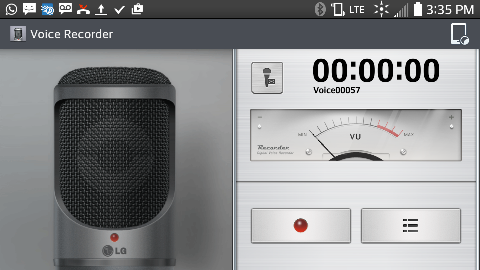
The voice recorder on my LG phone. This works.

Okay, now find someone you know and interview him. Someone you are close to and are comfortable around. You can place the phone on a table that can take both voices and begin, if you don’t have headphones.

Ask simple questions. Ask questions around something you are both knowledgeable about. For example, if you both like soccer, start with that. Like these:
  1. What do you think makes soccer unique from other sports?
  2. What got you interested in the game? Is there a particular personal story behind it?
  3. Is there a particular aspect of the game that you really like — tackling, scoring, dribbling, passing, teamwork, etc? Least favorite?
Just those. Start there, and leave enough time for a response from whoever you are interviewing.
Now playback the interview. How does it sound? What can you improve?

This is critical because you can only improve on something you have done, not something in your head. And the most important thing is to start.

With your lessons from this one, interview another person — your mom, dad, teacher, or brother. Review that one, too, and learn from it.

This series of interviews should give you a good degree of comfort to start with. Take it a step further and interview someone you are not very close to — like a co-worker or a neighbor. Do this enough times, like say 10 of them.

Do that, and now you have something under your belt, some experience. Don’t worry about mistakes, action is what matters, at this point. Many ideas have failed for lack of action and fear of mistakes.
Finally, to really use this skill to advance your career, find someone who is doing something you’d like to do — a professional, most probably, and interview them on their personal story in that industry, or what they’d like to share with a newbie in the industry. Just simply humble yourself and learn from them through the interview.

(If you’d like to be a teacher, find a good teacher in your town/city and interview him/her; if you’d like to be a chef, stop by a good restaurant and schedule a 15 minute interview with their top chef and learn; if you’d like to be a football coach, pick the brains of the local high school football coach in 15 minutes)

Or, like David Rogier, if you become really good at it, you can use it to land a job/internship. David wanted to land an internship at IDEO (a reputable product design consultancy company), so he used his interviewing skills to interview 23 people at an airport about baggage claims, created a book on all the insights he gained from the interviews and how he would improve the process. He found a way to share his findings with the company. He got the internship.

Or, use it to gain more skills by doing a local interview project around something you are passionate about. Like I did over 21 days with small business owners here in Austin, Texas. Seeing the initiative behind my project and the fact that I was documenting my journey online, one of the owners offered me a job application while I interviewed him, and another brought up the possibility of working on a project together.

So to keep it simple, you can organize a 14-day interview project around culinary skills, for example, and interview 10 chefs in local restaurants, and work on your writing skills by blogging your daily lessons on a simple blog.

You will come away with not only people skills, but you will work on your writing skills, your pitching skills (an ability to present your project’s idea to a professional to set interview appointments), create a relationship with whoever you interview, and come away with a story to tell.

But the most important thing is to start. Interview the first person.

Monday, January 18, 2016

Virtuosity

A) Identify one thing you love that is really hard for you.
 B) Do it
 C) Repeat B a lot.

Then you move from incompetent to competent. From competent to mastery. From mastery to virtuosity. [Thanks to my friend, Mark Ford, for breaking it for me into these four categories. It’s very true.] — James Altucher.

Virtuosity.

I saw it and thought about it for a bit. Why is it so termed, this degree of excellence? Okay, surely the root word is ‘virtue.’ What, then, is ‘virtue’?

Good moral standards, right? And then you think further, and realise that virtue is ‘vertical’s’ cousin. ‘Vertical’ is what we know as the upright, what leads upward, heavenward.

Is it a stretch, then, to say the highest form of excellence, the ‘virtuoso’ kind, is the performance that gives God glory? That shows forth God’s goodness as the giver of the gifts, the talents, the life, the strength, the wisdom, and all?

Surely, there’s a reason why the winner of the trophy lifts it upward at the end— not necessarily to thank the fans but to show the reward of the work to his Maker above.

Virtuosity.

Monday, January 11, 2016

Grammar Is Not Unimportant

Okay, this is a quick response to a recent feeling about grammar.

Grammar is understanding's aid, it helps people think clearly about things, and lends respect to the reader. There's a reason why order is needed with all things useful. Grammar is order.

Writing is an exchange, an investment. A man takes his time, which he could have used somewhere else to do something else, but chooses to spend it--invest it---in reading your work. Respect that. Think like this: Is this piece of writing worth his time? After he is done reading will he be better off as a person? Make your piece worthwhile.

Grammar helps the mind think, and a person's mind is his privacy, a very delicate part of him. So feeding this part of him with a rushed jumble--forgetting grammar---hurts the mind---and is harsh to it. Few people spend time hurting. So write, and write well.

Yet, in saying all this, there are still audiences for whom grammar may not be necessary, because it may not lead to understanding, and understanding should be the chief reason for writing. But then again, for most literate audiences grammar is crucial to helping the mind properly process what the writing is about.

Ever heard this saying by B.J Chute: "Grammar is to a writer what anatomy is to a sculptor and the scales to a musician, you may loathe it, it may bore you, but nothing will replace it, and once mastered, it will support you like a rock."

Alright, off to your slate. Write.

Monday, January 4, 2016

Write It Down

Write it down. You got something you want to do? Write it down. What is the topic? It doesn't have to be perfect. Just write it down. Do you want to start a small group ? Write down everything that comes to your mind about it. You can delete the bad stuff later. But when your mind's hot, ideas flow and come to you. Catch them all. Strike the hammer while the iron is hot, the old saying goes.

Why? Because there will come a time when your motivation wanes, and then you'll not feel as fired up, and ideas don't come to you as readily. This is not the time to try remembering what came to you when you were feeling good. A short pencil is better than a long memory, and strike the hammer while the iron is hot.

I Use A Pencil: The Experimenter's tool

Yeah, a pencil gives me freedom to experiment. A pencil is great for what's at it's butt---the eraser. We are not at the commitment stage yet, so let's feel free to try things out---check if a sentence is good or not, and use the eraser if not. A pen puts an indelible mark on the work, and makes changes messy---not time for that yet. On the bus, at the gas station, on the flight, I can quickly pull out a pencil and be off to writing.

Let's write.

You will get nothing useless from me. Be assured.

Get The Nuggets From My Projects

* indicates required