This site is to document my journey through projects to help individuals and small business owners with a couple things that could make a difference.
I do this via mini projects.I also write, and I recently released myeBook ( Get To Know Your Backyard Opportunity), based on the lessons from my 21-Day project here in Austin, TX.
This book is aimed at highlighting the initiative we can all take to gather valuable skills in writing, communication, and interacting with people through an interview project in our local communities. The benefits could be life-changing.
For strategic reasons, I will hold off on writing anymore posts on this blog until further notice. I'm working on a change which will be announced in due time. Any inconvenience is deeply regretted. All the best, and have a great weekend, everyone! ---Kingston.
We all have that friend who says they want to write a
book, right?
And surely, that’s a good thing, but most don’t do it for a few fears. I say write it anyway.
And here are a few reasons why it will make a
difference for at least one, which is where it all starts.
You may be thinking: There are so many books out there,
why write mine?
Okay, while that’s not the mindset to adopt, let’s take
a closer look:Although there are so many book out there, there are
also so many outdated books out there, there are dead books out there (books
that are not worth reading because they add nothing to anyone’s life) books
that are hard to read, books that lived out their usefulness, and books that are
not on the topic you will be writing about, or from the perspective you will
take it.
This takes out a lot of the mental barrier of thinking
there’s too much out there already. Write your book.
Won't sell? You don’t know that. Until you offer your
book you will never know, and that can torment you. I recently shared with a
friend that the pain of failure is far greater than the regret of not trying. And
even if you fail, you will have failed forward, and means you will have moved the
chains, made some progress.
Also, the experience of writing a book is also a benefit in
and of itselfbecause the exercise will
leave you a better writer than before, and surely you will write a better book
on your next try, if the first one’s not that great. Nothing is lost in the attempt.
To help you see how the sale could happen, here’s a
possible situation that makes people buy books: Let's say, for example, John is struggling with something you know a lot about---say, how to work on an oil rig, how to buy a home, or how to create a successful meetup group, and others like that.
And he is
strapped for time, doesn't want to read a big book, he has very little money or
doesn't want to spend a lot to get the knowledge, and he finds himself online searching for a book
on the topic you are writing about. If your book is well packaged, an easy
read, and is affordable, there's a good chance he will buy it.
Yet until you offer the book, the chance of this
happening is not even there. Create the chance. Write your book, at least for John.
I
know, I know, a lot of people want to write a book, right? And surely it’s a
good desire.
Why I think so? Every living human has a story to tell, because to live is to
live out your story. And if every story is unique, and stories have lessons,
then everyone has something to say, something to teach, something to give.
And
to give, you need a medium to do it. If you choose to use a book to share what
you know, here are a few baby steps.
The
writing process comes out of life, out of living, and you know living happens every
day and everywhere. And that’s why your content can be found anywhere.
But
how do you capture your content? One of the easiest ways to do so is to keep a
notepad with you. A notepad should not be far off wherever you are---the ideas
for your book can hit you at any time, and some of the best hit when you least
expect them. Some of the finest lines could come to you when you are eating,
walking about, in a conversation with someone, and so on. You get it.
And
since a short pencil is better than a long memory, capture it before it flies
off. There's often too much going on in our lives to commit things to our
memory, but a pencil keeps it noted.
Why
wait till you sit down to think up your ideas? Heard of the writers block,
right? Yeah, often it hits the very moment you sit to punch the keys.
And
this note-taking habit is shown in one of my favorite movies, Finding Forrester. Ever seen it? Derek
Luke, who plays the Jamal, the young man who befriends William Forrester, Sean
Connery's character in the movie, always carried a back pack with him.
In
his backpack, he had a little notebook
which he used to write down some of his favorite lines. In the movie, he
ends up losing his backpack while he and his friends, out of curiosity, visit William
Forrester’s apartment. To them the old man was mysterious and they wanted to
find out who he was.
They
get spooked and ran off, and Jamal leaves his bag behind. William ends up
looking through his backpack and notices the young man’s writing habit and some
of the lines he had penned. These little pieces of sentences are what the
renowned author sees and likes, even comments on them in his notations in
Jamal's book. This ultimately became the tissue/link to their friendship.
Great
pieces equals a great book, and these pieces could come to you at the beach,
the grocery store, in a conversation. So always have a pen at the ready or your
own writing software.
I saw the headline: 1,142 Decisions For Christ — Hill Country Bible Church sign.
Decisions? Decided? To decide?
Break down the word and you see why it can be hard. To decide is to kill.
Surely ‘cide’ means to kill, right? As we see in homicide, pesticide, and germicide. To decide, then, means to kill a choice in favor of another.
Surely few people ran happily to kill or take something or someone out. This is where the heart tugs leave many of us undecided, indecisive. It can be uneasy.
Yet, we must decide, for we can’t have it all, and progress depends on deciding, choosing. So kill the less desirable alternative for the better one.
We all need skills. Nothing worthwhile is possible without them.
And one of the best is people skills. Technology cannot touch that.
Without
much labor on this point, people skills are important. The whole thing
starts and ends with people, you know. So gaining a good handle on how
to deal with people is key to a whole lot.
How,
then, can you start working on yours, if you feel unsure when
interacting with people? How can you get comfortable having meaningful
conversations with others?
A
simple conversation where you set out to learn is all it takes.
Interview others as a way of learning from them, and get the by-product
that comes with it: experience and a relationship.
Here’s an easy way to get started.
Take
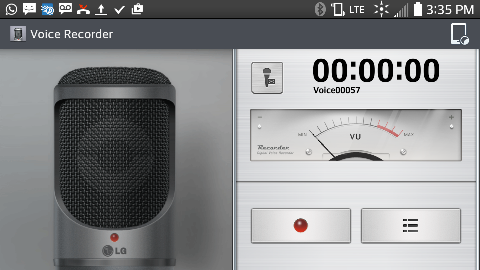
out your smartphone, and look for the voice recorder that came with it
(it should be one of the apps that came pre-installed). Plug in
headphones that have in-line microphones and test it out. Say some words
into it. Play back the audio to yourself. Good? Works?
The voice recorder on my LG phone. This works.
Okay,
now find someone you know and interview him. Someone you are close to
and are comfortable around. You can place the phone on a table that can
take both voices and begin, if you don’t have headphones.
Ask
simple questions. Ask questions around something you are both
knowledgeable about. For example, if you both like soccer, start with
that. Like these:
What do you think makes soccer unique from other sports?
What got you interested in the game? Is there a particular personal story behind it?
Is
there a particular aspect of the game that you really like — tackling,
scoring, dribbling, passing, teamwork, etc? Least favorite?
Just those. Start there, and leave enough time for a response from whoever you are interviewing.
Now playback the interview. How does it sound? What can you improve?
This
is critical because you can only improve on something you have done,
not something in your head. And the most important thing is to start.
With
your lessons from this one, interview another person — your mom, dad,
teacher, or brother. Review that one, too, and learn from it.
This
series of interviews should give you a good degree of comfort to start
with. Take it a step further and interview someone you are not very
close to — like a co-worker or a neighbor. Do this enough times, like
say 10 of them.
Do
that, and now you have something under your belt, some experience.
Don’t worry about mistakes, action is what matters, at this point. Many
ideas have failed for lack of action and fear of mistakes.
Finally,
to really use this skill to advance your career, find someone who is
doing something you’d like to do — a professional, most probably, and
interview them on their personal story in that industry, or what they’d
like to share with a newbie in the industry. Just simply humble yourself
and learn from them through the interview.
(If
you’d like to be a teacher, find a good teacher in your town/city and
interview him/her; if you’d like to be a chef, stop by a good restaurant
and schedule a 15 minute interview with their top chef and learn; if
you’d like to be a football coach, pick the brains of the local high
school football coach in 15 minutes)
Or, like David Rogier, if you become really good at it, you can use it to land a job/internship. David wanted to land an internship at IDEO (a reputable product design consultancy company), so he used his interviewing skills to interview 23 people at
an airport about baggage claims, created a book on all the insights he
gained from the interviews and how he would improve the process. He
found a way to share his findings with the company. He got the
internship.
Or, use it to gain more skills by doing a local interview project around something you are passionate about. Like I did over 21 days with small business owners here in Austin, Texas.
Seeing the initiative behind my project and the fact that I was
documenting my journey online, one of the owners offered me a job
application while I interviewed him, and another brought up the
possibility of working on a project together.
So
to keep it simple, you can organize a 14-day interview project around
culinary skills, for example, and interview 10 chefs in local
restaurants, and work on your writing skills by blogging your daily
lessons on a simple blog.
You
will come away with not only people skills, but you will work on your
writing skills, your pitching skills (an ability to present your
project’s idea to a professional to set interview appointments), create a
relationship with whoever you interview, and come away with a story to
tell.
But the most important thing is to start. Interview the first person.
A) Identify one thing you love that is really hard for you. B) Do it C) Repeat B a lot.
Then
you move from incompetent to competent. From competent to mastery. From
mastery to virtuosity. [Thanks to my friend, Mark Ford, for breaking it
for me into these four categories. It’s very true.] — James Altucher.
Virtuosity.
I
saw it and thought about it for a bit. Why is it so termed, this degree
of excellence? Okay, surely the root word is ‘virtue.’ What, then, is
‘virtue’?
Good
moral standards, right? And then you think further, and realise that
virtue is ‘vertical’s’ cousin. ‘Vertical’ is what we know as the
upright, what leads upward, heavenward.
Is
it a stretch, then, to say the highest form of excellence, the
‘virtuoso’ kind, is the performance that gives God glory? That shows
forth God’s goodness as the giver of the gifts, the talents, the life,
the strength, the wisdom, and all?
Surely,
there’s a reason why the winner of the trophy lifts it upward at the
end— not necessarily to thank the fans but to show the reward of the
work to his Maker above.
Okay, this is a quick response to a recent feeling about grammar.
Grammar
is
understanding's aid, it helps people think clearly about things, and
lends respect to the reader. There's a reason why order is needed with
all things useful. Grammar is order.
Writing
is
an exchange, an investment. A man takes his time, which he could have
used somewhere else to do something else, but chooses to spend
it--invest it---in reading your work. Respect that. Think like this: Is
this piece of
writing worth his time? After he is done reading will he be better off
as a person? Make your piece worthwhile.
Grammar
helps
the mind think, and a person's mind is his privacy, a very delicate
part of him. So feeding this part of him with a rushed
jumble--forgetting grammar---hurts the mind---and is harsh to it.
Few people spend time hurting. So write, and write well.
Yet,
in saying all this, there are still audiences for whom grammar may not
be necessary, because it may not lead to understanding, and
understanding should be the chief reason for writing. But then again,
for most literate audiences grammar is crucial to helping the mind
properly process what the writing is about. Ever
heard
this saying by B.J Chute: "Grammar is to a writer what anatomy is to a
sculptor and the scales to a musician, you may loathe it, it may bore
you, but nothing will
replace it, and once mastered, it will support you like a rock." Alright, off to your slate. Write.
Write it down. You
got something you want to do? Write it down. What is the topic? It
doesn't have to be perfect. Just write it down. Do you want to start
a small group ? Write down everything that comes to your mind about
it. You can delete the bad stuff later. But when your mind's hot,
ideas flow and come to you. Catch them all. Strike the hammer while
the iron is hot, the old saying goes.
Why? Because there
will come a time when your motivation wanes, and then you'll not feel
as fired up, and ideas don't come to you as readily. This is not the time to try
remembering what came to you when you were feeling good. A short
pencil is better than a long memory, and strike the hammer while the
iron is hot.
I Use A Pencil: The
Experimenter's tool Yeah, a pencil gives
me freedom to experiment. A pencil is great for what's at it's
butt---the eraser. We are not at the commitment stage yet, so let's
feel free to try things out---check if a sentence is good or not, and
use the eraser if not. A pen puts an indelible mark on the work, and
makes changes messy---not time for that yet. On the bus, at the gas
station, on the flight, I can quickly pull out a pencil and be off to
writing. Let's write.