purpose

(For every page's details, please scroll down.)

I am Kingston, and this is my project page.

This site is to document my journey through projects to help individuals and small business owners with a couple things that could make a difference.

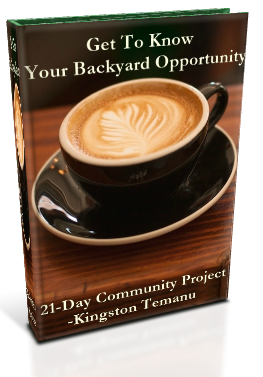
I do this via mini projects. I also write, and I recently released my eBook ( Get To Know Your Backyard Opportunity), based on the lessons from my 21-Day project here in Austin, TX.

This book is aimed at highlighting the initiative we can all take to gather valuable skills in writing, communication, and interacting with people through an interview project in our local communities. The benefits could be life-changing.

Update Note: In the meantime, you can also pick up a free copy of my released mini-guide: Start With A Story: A Mini Guide On Opening Your Book With A Tale.

And also check out my latest startup in NYC, Kilimanjaro.

spacer 2


Saturday, November 7, 2015

Why Writing Is A Cornerstone For Any Project


Why Write?


This is an excerpt from my upcoming book Get To Know Your Backyard Opportunity, a guide that shares my story of interviewing small business owners in Austin, Texas, and the lessons in personal development that I came away with. It also doubles as a guide to help anyone anywhere take initiative on something they love via a similar project in their own local community. This is a chapter on why blogging/writing is key to making the most of the project.
 
Why Write?
 
Grammar is to a writer what anatomy is to a sculptor, or the scales to a musician. You may loathe it, it may bore you, but nothing will replace it, and once mastered, it will support you like a rock. — -B.J Chute.


Okay, first thing, we are not talking about grammar, not entirely. Yeah, it will come in handy later, but let me draw a bit from the quote above.

Writing is a ‘flesher’ of thoughts. It brings order to things said, and is one of the greatest skills you can develop. Why? Clarity is a quality of all great thoughts, and anything that has to be put into writing challenges the writer to think more carefully — he has to put one word after the other to make a point — and bring out what’s not necessarily clear.

Why not just say it, you may ask? Well, you could, but the spoken word unless written down gets taken up by the air, and is lost forever. What about the memory? Well, it could be collected in the memory, but in time the memory fades. So to rely on it is to leave you scratching your head when it comes time to recollect it for use. And definitely what cannot be retrieved cannot be used. Herein comes the point of this saying: A short pencil is better than a long memory.

But in saying all this, for our purposes here, I do not mean excellent writing. I mean the ability to put down a decent record of your thoughts so that others can read and see what you mean, and at this point mistakes are allowed — that way starters can grow and get better. This is why I do not stress strict grammar, but the ability to start practicing now.


Marco Polo

Okay, let’s look back a little. Let’s see why you know Marco Polo, or the Marco Polo sheep.

Growing up as a kid, I heard a bit of the Marco Polo sheep but didn’t quite understand why the sheep was so named. Later in life, I read a piece somewhere of Marco Polo and why he is renowned worldwide for his documentation of his travels to Asia, and how his book — “The Travels Of Marco Polo”— was Europe’s introduction to Central Asia and China.

But wait, was he the first, or was he the most knowledgeable person about that region of the world at the time? Enter Wikipedia:
Marco Polo was not the first European to reach China (see Europeans in Medieval China), but he was the first to leave a detailed chronicle of his experience. This book inspired Christopher Columbus and many other travellers. There is a substantial literature based on Polo’s writings; he also influenced European cartography, leading to the introduction of the Fra Mauro map. — Wikipedia

There, is the power of the pen, which is said to be mightier than the sword. Well, in our day, it will be punching the keyboard, right?

Yet you may say to me, “Kingston, nah, I am not Marco Polo, I am not that big.” Well, we all have to start somewhere, right? We all can’t be great from the outset. We have to start where we are, though, and use what we have, build a muscle for whatever skill we desire, and then see what opportunities come our way to use it.

Time and chance happens to all things, and I am sure Marco started writing, or had a great appreciation for it at a much earlier time in his life, and took other previous opportunities to write about other projects before he penned the famous book. That writing of the book was actually a chance he took to write it — he could have chosen not to. Plus, his expedition to Central China or Asia, in a large sense, was a project, too.

But what’s more? The likelihood of influencing Christopher Columbus would not have existed without Marco putting pen to paper.


What About This Project?

In this case of a project, how useful is writing? In a number of ways: One, it’s a way of creating a story for yourself while you go about the project. There are many things that will happen during the project, and not recording it means a lot is lost along the way. I see value in all things, and so the chance to record my discoveries, conversations, observations, and even mistakes, gives me a record to look back on. This record is a store of things to learn from, things to improve on, and proof that this actually happened.

Two, you need a platform. This is why I talk about starting a blog. When you start a project like this one, with the few people you may share it with or whoever will know about it ( or even the professionals you end up interviewing), they will like to follow your progress, and reading is how they do that.

So in that sense, reading is how they consume what you are creating. Reading, then, is a form of consumption. It’s like eating, and proper eating demands that food be served on a plate. Your project is something you are serving to others. So serve it on plate, a platform — which is what a blog is. It’s simply a “form” of “plate,” and writing is the tool you use to put it on that plate.

This very book you are reading itself is a platform. There has to be a ground upon which I share my story and the lessons. The story is my ground, and the book is my writing pad, my platform, and I typed the words onto the “plate.”

Three, writing on a platform like a blog, sets you up to share your findings. The project will lead you to discoveries, not only about your neighborhood, people, or situations, but your own self and your passion. Make sure you note those — discovering things about yourself is your great key to thriving on the earth. And when you will like to share some of these, a blog gives you a tool with sharing powers — the social media buttons ( Facebook, Twitter, Instagram, Youtube, and others) — to easily distribute it.

Also, the more you write, do projects, and share your thoughts, the more the right people will come to you. The reason people are hesitant to come to connect with others is a lack of information, uncertainty. Lack of information is like walking in the dark, and few people like that. Knowledge is light, and the more you share, the more people know about you, and makes it easy for others to decide how to connect to you, based on what you are sharing. This is how writing improves your chances of getting where you want to go — by connecting you to the right people.

The president of the United States, president Barack Obama, is a writer. During his initial campaign for president, I heard stories here and there about how he sometimes writes his own speeches. How does being a writer help him? Well, in a few key ways.

Connection  — I’m sure some folks read his books (“Dreams From My Father” and “ The Audacity Of Hope” )— especially during his initial campaign for president as a way of knowing more about him as a candidate, and in the process saw his thinking process and what he believed. They then checked if they agreed with him or not on the issues at play for the presidency. For those who did, they easily voted for him. That writing, someway, somehow, helped pave the way for his election. It supported him and connected him to the right people.

So it is with all of us. Your ability to gather your thoughts, package it, and use it to make a point is a rare skill. Not everyone can do that. But you can start small, and with a project that you enjoy, and write all about it. In time, you’ll get better.

Even the great God Himself who created all things, when He sought to record His thoughts, He put it in a book for men to read. This is how we know His will.


A Premise, and Like A Rock

What’s more? The United States Of America, a great experiment in nation building on the face of the earth, in her attempt to free itself from colonial rule, wrote a document that clearly spelled out the grounds upon which they will like to rule themselves, free themselves of the United Kingdom. The document laid clear reasons for what they wanted to do, why they wanted to do it, and shared it with all. Out of this document, in a large sense, the constitution was written, which today governs the country. 

That’s how writing will support you like a rock, as B.J Chute points out in the quote above that starts this topic.

In the same way, you should also, if you were to work on your own personal project, write out a small statement that spells out your mission for the project, and make it clear on your blog. Nothing big, nothing special, just a few words that spell out what you are doing and why you are doing it.

Here is mine:
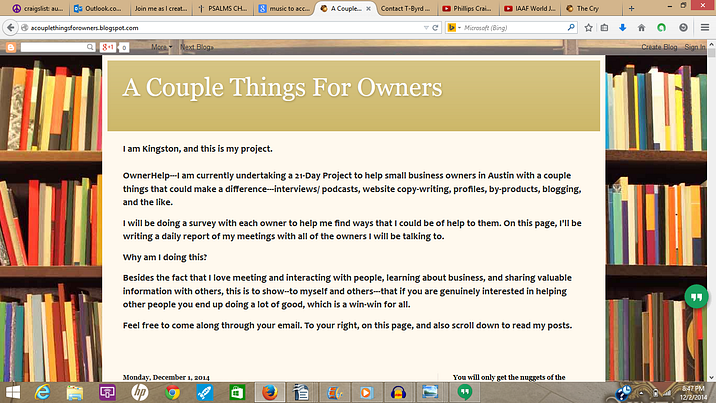
This is what some owners saw on my blog when I introduced myself. They checked it directly, sometimes in my presence, and said, “Okay, let’s talk.”

That’s how writing can be a support —a tool to help you state your grounds and make things clear.

For you, some good questions to ask, if you were to write yours will be these: Is my purpose clear enough? Does it show why I am doing what I am doing? Is it with goodwill, is it well-meaning, does it serve others besides me?

Write the vision, and make it clear upon tables that he may run who reads it — Habbakuk 2:2

Again, it doesn’t have to be perfect at the outset. No, don’t even worry about that. No one starts out perfectly. Just get your thoughts on to the page in as decent a form as possible. Also, notice in B.J Chute’s quote above how it talks about a process — “…once mastered, it will support you…”  — -showing that it’s a process, and you won’t start out with great writing, but in time, you will master it. It’s the same with everything else and everyone. I’m still learning and striving to be better everyday myself.


Warren Buffet & Basecamp Inc.

Let’s take a quick look at something I read not too long ago. Recently after logging out of my email, an MSN page came up with this headline: Buffet: Stop Blaming The Rich For Income Inequality. The title had Mr. Warren Buffet’s photo behind it. The piece was originally published in the Wall Street Journal on May, 21, 2015.

But far from the meat of the topic is how Warren Buffett got his thoughts out. The author, Dan Bigman, put it like this:
“Buffet, whose net worth we clock in at $71.3 billion, wrote in a Wall Street Journal Opinion piece published yesterday…” — Dan Bigman

Again, let’s not to get into the meaning of the topic, but worthy of note there is one word: Wrote. He wrote. Yeah, writing makes a man exact, as is often said.

There was a matter at issue in the public realm, and Warren Buffett sat down, took out a tool, and made his thoughts clear. He wrote it out. After that, he shared it on a platform, the Wall Street Journal— and from there it was easily distributed, which is how it got to me. But after writing, Mr. Buffet did not spend another ounce of energy to say more. His written piece takes over and does the rest of the work.


How About Getting A Job?

Well, I will again tap into the New York Times bestselling book, Rework, by Basecamp Inc. Basecamp, the company, formerly 37 Signals, is run by Jason Fried and David Heinemeier Hansson. They are a software company based in Chicago.

Why they matter? They are the makers of the popular project management app Basecamp, among other apps, and created Ruby On Rails which is used by a good percentage of programmers and designers today. They also wrote the books, Rework and Getting Real.

In Rework, they stress the importance of hiring writers. Here:
“If you are trying to decide among a few people to fill a position, hire the best writer. It doesn’t matter if that person is a marketer, salesperson, designer, programmer, or whatever; their writing skills will pay off.
Why?

That’s because being a good writer is about more than writing. Clear writing is a sign of clear thinking. Great writers know how to communicate. They make things easy to understand. They can put themselves in someone else’s shoes. They know what to omit. And those are the qualities you want in any candidate.” — Rework, page 222.

Key words to sense out of that? Empathy — they can put themselves in someone else’s shoes. Clear thinking — bringing order to a mental jumble. Clarity — they make things easy to understand. Concise — they know what to omit. All these point to an ability to communicate, and this is one of the chief benefits of doing a project like this, writing about it, and working and being on the same page with all the people you interview through clear communication. Again no one starts out great at this. Start small.

End Of Sample


Monday, October 26, 2015

Trash To Value

After getting a good morning workout in, I decided to take a longer route back to the apartment, and as a way of doing something different. I often do this to challenge my mind to be accepting of new things, and to break routine.
This year my neighborhood got a new garden that we’ve all come to appreciate very much. From what I hear, it all came about after one lady decided to request the previously abandoned plot of land from the City of Austin and make a garden of it. How the back and forth went, I don’t know, but when the city gave permission and folks broke ground, I enlisted to volunteer to help get it in shape and create beds for the garden. We got it done, fenced and all.

So it’s all a pleasant morning stroll, or at anytime of the day, when I walk by and see the transformation, as my mind goes back to what it used to be like. Members of the community have bought beds and are growing all kinds of plants, flowers, vegetables, and the like there.

But with gardening comes things to buy, right? That’s how mulch found it’s way to the garden. A huge pile of it is set aside right next to the garden for use.
So that morning, I stopped by to take a close look at it — the mulch. It looked like trash, and it was, and it isn’t.

I scooped a bit into my hand and took a close looked at what it’s basic ingredient — pieces of leaves, wood scrap, little tree limbs, and all — is.


I thought again of where all these pieces came from. Literally trash, but now in the right situation, for the right purpose, packaged well, it’s a product that people pay for.
Wait, that’s worth thinking over.

What if I took this scoop in my hand home with me. Surely, it’s worth nothing.

Yet, what if I took it to the bank?“Away with this” they’d say.

Still, with enough of it, and in the right environment, to the right buyer, that’s value, worth spending money on.

That definitely should get me thinking. What’s my trash? Is it value? Do I have enough of it? Is it well packaged? And do I know who will find it useful?

Only one thing comes to my mind: Nothing on earth is useless if positioned right.

I wouldn’t be writing this, if this lesson was relevant to only me. But what’s your trash? Do you see it? What is it worth? Who would find it valuable?


By-Products

One of the finest lines in creativity I have read came from the book Rework, written by the founders of the project management app Basecamp, Jason Fried & David Heinemeier Hannson, is this:


When you make something, you always make something else. You can’t make just one thing. Everything has a by-product. Observant and creative business minds spot these by-products and see opportunities.

See, I stopped there that morning to check out the mulch largely because since reading those lines I have decided to pay closer attention to things around me.

They go on, in the book:


The lumber industry sells what used to be waste — sawdust, chips, and shredded wood — for a pretty profit. You’ll find these by-products in synthetic fireplace logs, concrete, ice strengtheners, mulch, particleboard, fuel, and more.

And yes, the mulch at the garden is a by-product from a tree’s death — dead leaves, broken pieces of it’s limbs, wood chips, and others. So in a sense, out of death has come life, if you see it — the packaged trash is sold to gardeners and that puts food on someone’s table, helping someone make a living.


Monday, October 12, 2015

A New Blog For Silver Grill Cafe


I remember walking into the restaurant that day. The place looked inviting and I wondered why I had never been here, though I lived in the same neighborhood. I could imagine myself sitting there with a friend over dinner while watching a game at the same time ( they have TV sets on the walls). 

If you know about my original 21-Day project, which my upcoming book is based on, you may recall my blog post for one of the last days that featured when I first stopped by Silver Grill to set up my interview.

Fast forward almost a year and now I will be writing for Silver Grill Cafe. Rehan Awan, the owner, and I have had a cordial relationship since I interviewed him, and we've gone over ideas on how to improve parts of his business and public relations---email newsletters, menu revamp, advertising, interior decoration, and others.

I offered to help him set up a blog on his website and explore what narrative we can create to build a degree of communications with customers. He thought it over, and we went back and forth for a while, and finally decided to give it a shot. Let's try it, he virtually said. Cool, I thought, let's do it, then!

Now, it's all systems go So from now on, I will be running his new blog. I will create a new page on his website titled “What's Happening” and share with the world all that's going on at Silver Grill Cafe.

If you live in Austin, and are in the neighborhood feel free to stop-by and check out the place. Just remember to say you read about his shop on this blog, Kingston's blog---it should get you a knowing smile, if nothing at all.

So with all that said, here we go. Since I like to do pretty much everything by projects or seasons, I'm committing the next 2 seasons----Fall and Spring to this project. That's 3 months to each season. To a good six months of blogging for Silver Grill Cafe.

What you can expect? There will be a blog post a week---once a week, and the topics will range from menu options, in-store stories, and all that's working and not at Silver Grill. Stay tuned.

Wednesday, September 30, 2015

Respecting A Penny

There’s no dollar without a penny

While I walked across the bridge, I noticed it on the ground, bruised, run over, and losing it original color. It looked worthless, and I’m sure many have stepped over it, without giving it much thought. But I picked it up. I picked up the penny.
I thought of this habit of mine, and how it affects other aspects of my life. I thought of the value that little things have, and how most seem to miss it, and decided to share the summary of it, knowing that a dollar is not possible without a hundred pennies. 

Here it is:

If you don’t respect a drop of water, you can’t have the ocean. Being faithful in the little is the way to start work on great things. The next time you find a penny on the floor, pick it up. I say this for 2 reasons: One, it’s money — -it’s not worthless; two, and more important, it serves as a reminder to you, in building a better mind, to respect every little thing of value, and the mindset is more important than the amount of wealth you have. Your mind is you.
This thinking is necessary for any creator or person set on making great things. Understanding that things that seem small in value could be turned into very valuable products is at the heart of creativity.
This does not go for only pennies, but many other things in our lives: a glass of water turned into bottled water, and sold; a page of a book — many pages make a book; a sentence, many of them put together becomes a story, and a book; and many others. It all begins with the little things.
Dust is the parent of a star!-Munia Khan

Monday, September 21, 2015

Begin Building An Audience Today!

 Build An Audience For Your Business

Au-Build

 This is for small business owners: coffee shops, convenience stores, restaurants, barber shops, print shops, etc.
 
 Okay, let's keep it simple, you own a shop, and have people buy from you everyday. Your transaction with your customers is simple: they come in, buy what they want, pay you and leave. Nothing more, nothing less.  

Once the transaction is over, there's no further interaction, unless they decide to come back to you for something else. Notice I said "they decide." Otherwise, they are gone, the transaction is over.

But let's step back a bit, and take another look at the transaction. If I were to buy something from you, let's say a toothbrush, there's a chance you that might still have in stock something that will be useful to me (like a toothpaste) and being a human being, when the need arises, when I run out of toothpaste, I will look for a place to buy it from. What's the likelihood that I might come back to you? Unknown, it depends, 50-50, right?


Let's look at a different scenario. Let's say instead of the nameless store/business owner,  I have a relationship with you, one that's decent and based entirely on your courteous customer service and the value you provide me as your customer? 

What if I had a relationship with you that gives me a chance to know you more, to hear from you from time to time through email, beyond my being in the store. What if you gave me special discounts occasionally that saved me a decent chunk of change. What if you sent me information that makes a difference in my spending, and helped ease my way through life. 

What I am saying here is that if you want to build a hearing with your customers, a relationship that's more that a one-and-done experience, build an AUDIENCE. A group of people that received goods from you from time to time. 

Building an audience helps a business last, because after all, the business is nothing without the customer, right?

Hence the customer is king, and learning to build a relationship with the customer, and creating an audience through the process is critical to your business, in that sense. 

So the next obvious question is how to this, right? That's why I built this service. But let's take a look at some reasons why customers will give you access to them, give you their email to be precise.


Incentives

Why people will give you email access?

  1. Save money
  2. Tips and instructions
  3. Freebies
  4. Giveaway Contests
  5. Insider Information---A behind the scenes education.

    I list these to highlight the essence of the exchange: Email for Value. Or something for something.


 Let's look at a quick breakdown of what it will take to build a strong customer base, or audience.

What if we wanted to gather 10,000 emails in one year?

Working Backwards:

With 52 weeks in a year, how many emails do we need in a week?

10000/52 weeks = 192 emails a week

Okay, so how many do we need in a day (this depends on how many times you are open for in a week? Let's say 5 days.

192/5 days= 38 emails a day!

Yet, how many hours is your shop open for?

5 hours? 6 hours? 9 hours?

Let's say 8 hours.

38/ 8 hours = 4.8 emails, which is roughly 5 emails an hour!

5 emails in an hour!

Benefits Of An Audience

  1. Test products
  2. Way to share your stories of the day, week, or month to lift spirits.
  3. Very little need for advertisement expense because you have access to an audience to get your word out.
  4. Better understanding of your customers, for it's only in understanding your customer's need that you can serve them well.
  5. A way to give value---job announcements, information, correct opinions, apologies, announcements, etc.
  6. A tool to organize meetings, webinars, surveys, seminars, etc.
  7. To teach lessons about parts of your business.

    Uncertainty?
    Yes, that comes with all things, so even if you come short of your expected number of emails, you will still have a considerable number of emails with permission to be contacted. The goal is to build a core group of customers who are representative of the typical people you want to serve. 

    Is that a good investment for your business? Also, if that's a good investment, what's the lifetime value of a customer you have a relationship with, who buys from you over 5 years, 10 years, 15 years?


    Delivery and Fulfillment: How Do I Do This?
Delivery starts with a free demo for two or three days. After those days, you decide if you want the system installed in your business, based on the results of the demo.

If you decide to install the system, I will start the installation process by working on-site with you, in-store, for 1 or 2 weeks, for 5 hours a day after which, if you like it, I will train your staff to do it for a whole year to reach your goal.

How Much Does It Cost?

I bill by the week, so it will cost you $ 500 a week. That's only $1000.00 for 2 weeks, plus staff training, email gathering, and email system set up.


More Questions?


Or, book me below:

Book an appointment with A Couple Things, By Kingston using SetMore

If you have any more questions, please contact me here: Kingston at acouplethings70@gmail.com.

Thanks.

Thursday, August 27, 2015

Your By Products

A quick share today from one of my favorite books---Rework, from the founders of Basecamp, Jason Fried & David Heinemeier Hannsson---on what you may not be seeing while you are working on your thing. Think calmly and well about this:


"When you make something, you always make something else. You can't just make one thing. Everything has a by-product. Observant and creative business minds spot these by-products and see opportunities.

The lumber industry industry sells what used to waste----sawdust, chips, and shredded wood---for a pretty profit. You'll find these by-products in synthetic fireplace logs, concrete, ice strengtheners, mulch, particleboard, fuel, and more.

But you're probably not making anything. That can make it tough to spot your by-products. People at a lumber company see their waste. They can't ignore sawdust. But you don't see yours. Maybe you don't even think you produce any by-products. But that's myopic."


Thursday, August 13, 2015

And Not For Books Only

Another sample out of my recently released book/guide "Start With A Story: A Mini-Guide On Opening Your Book With A Tale." Hope you take something away. Enjoy!
.................................................. 

And Not For Books Only

I pulled the phone out of my pocket, tapped the ‘Apps’ icon, and clicked the Google Chrome App Icon. It opened up and led me to a number of website windows that I had left open up after reading them. I simply leave them open to sort of stir my thought when I get back to them. These are ideas, and in my mind, I am not done with it, I am not done with them yet.


Thoughts are like pieces of meat to me, and until I am fully done chewing them, thoroughly, having gotten the most of out of it, I always return to them to finish up.


And today, I am on my way to Walmart, riding the public bus. The trip will be about 2 hours, and since it’s morning, my mind’s well rested to take in new information. Let me make the most of the time, I decide. I knew I had read a bit of Nathan Kontny’s pieces, but I wanted to dig in a little further.


So I went through the titles on his blog, Ninjas and Robots, and landed on this one. The blog Ninja’s and robots has not been active since Nathan Kontny took over the CEO position with Basecamp’s Highrise, but the remnant of his work is still valuable.


So I got started on a piece about becoming what you are looking for. Nathan titled it “How Do I Find Someone To Help Me?”


After a brief introduction of the topic, Nathan went on to start his point with a story.


Here’s the beginning:

In the late 80s, there was a teenage actor who was doing well finding movie roles. But as quick as his career started, it stuttered.


So he fell back to Plan B, and went to college. But he couldn’t let the acting bug go away. He kept looking for and landing parts. Then in his final year of college, he landed the best role of his life — a starring role in a movie filled with A-list actors and a great director. This was an Oscar-worthy movie.


So he quit school and moved to LA to pursue a professional acting career full-time. Except the movie bombed.


Critically, it did well. But it was a box office dud. And his hope that this was his stepping stone to stardom was squashed. He was back to being a largely unknown actor, sleeping on friends floors in LA, with endless competition. He’d get an occasional minor role, but was making less than when he was a teenager.


He needed a breakout role. But no one was giving it to him. So he decided to do it himself. He dusted off a script he had started in college, and with a friend put serious time into turning the half written document into an actual screen play.


I’m sure you are still reading and are engaged. Yes, you should. The story is interesting and on many levels you can learn something from it, whether it ends poorly or not. If it ends poorly, it’s a cautionary tale; and inspiration, if it ends well.


But this one ends well. The story is about how the movie Goodwill Hunting came into being. The guy in the story is Matt Damon, and the friend who helped out was Ben Affleck, and their story is now well documented. From Nathan’s account of it, the movie premiered on Christmas day, 1997, made 227 million dollars and was nominated for nine Academy Awards. It won Best Original screenplay for Matt and his good friend, Ben Affleck. Personally, I have seen it and consider it a great movie. Also, I have heard tennis superstar Roger Federer also name it one of his favorite movies. But what could have not been!


Yet after sharing this story, Nathan goes on start a new section of the same article that he subtitles ‘Become that which you seek.’ It’s at this point that he starts to tell his own story and starts making his real point to his reader. Here’s the lead up:


Every day I bump into someone struggling to find someone to help them with their project or career. They are business people looking for technical co-founders or people like me at Inkling looking for someone like me to write about me.


Now, from all these years in business, I realize that Matt Damon had it right. Instead of looking for some executive producer to give him a starring role, he was going to become the executive producer.


And to hit home the article’s other point, that becoming what you are looking for also brings you closer to people who could help you, Nathan pointed out how Matt Damon also met Steven Spielberg on the same movie set. And Spielberg later cast him for another movie, Saving Private Ryan.


I’m sure you know by now where Nathan is taking this article, or what he is trying to say.


Now, imagine Nathan takes out the story and goes on straight to talk about how the reader should simply become what he is seeking. That will be flat and uninteresting, right?


This again is the power of the story, and in this case not only to engage but to teach. Lists may do well, but nothing drives home a point like a story. Like a kind of burr, it has the ability to stick in your head. And in this case, it works as well even in starting an article. And for some, you may not write a book, but when you sit to write a blog post or an essay, consider the power of a story to drive your point home.


Also, remember, reading is an experience and it should be time well spent. So, making your writing interesting by weaving stories into them makes it a great trade of time and attention with your reader. This is, in a sense, a kind of reading UX (user experience), and you know it’s all the rave now in tech circles all over with software. In that same way, delight your reader, and let them know their time is well spent with your work.


The Place Of A Preamble

At this point let me point out a little difference with Nathan’s article. The article, is a bit of a variant, though, because though you should start with a story, there are situations where a preamble could lead the way first, and that’s what Nathan did with this article — he used a preamble before getting into the story.


As an article, the reader comes to it with little or no background information, and this is what a preamble helps with. It gives the reader a good idea of what the article is about. This is not the case with a book since you often know what the book is about from the title and subtitle. And if there’s no subtitle, the book’s description on the site, or on Amazon will clue you into what the book contains. And that’s when you already have a fair idea of the book’s content, and a story makes a great start without the need for a preamble.


What If I Started Differently?


Notice I start this section with a story, my story of how I found this article. Surely, I could have chosen a different start, maybe a mundane telling of the story. For the purpose of degrees of creativity, let’s take a look at an alternative start.


Like this:

This past Saturday, on my way to Walmart, I read an article about how to become what you are looking for. The article was written by Nathan Kontny, the CEO of Highrise, a software company in Chicago.


In the article, Nathan makes his point by telling a story first before going into his….and on, and on… (you get the point).


Do you notice how the facts are the same, but the telling could be different? This is the same thing with life itself. We all have our cards, our facts, but it’s all based on how we play them. How we use them is what makes the difference. Some of us use it all, some use little, and some use none. But in the end, let’s use it creatively, let’s tell it creatively, with interest.


And that’s another reason I doubt anyone who says they don't have an interesting story to start a book or an article with. It’s there!

If you enjoyed this piece, you'll enjoy the whole book/guide. 
.................................

Check it out here: Start With A Story: A Mini Guide On Opening Your Book With A Tale


Friday, August 7, 2015

A Free Sample

A free sample out of my guide. This is directly out of Gumroad's small product lab. Enjoy, and click the link below to get the whole book.

...............................


Whose Hat Is This?


The hat dropped, and he looked at the name on it, wondering if he had an idea who it was for. The hat previously sat atop someone’s head, surely, and now it had collected dust, a sign of its tale — -it’s been unused for a long time. It’s had a long journey as someone’s head gear, and now as no one’s.

But where he found it is a good place to start if he is to find who last owned it. It was nestled in a corner of the street near a coffee shop. The coffee shop itself had long been in that location, and is a local favorite. And for tales, the coffee shop had it’s share of many, some documented, some told, some swept under the carpet, some not to be uttered.

Well, the hat’s interesting and it’s not too far from the coffee shop. What can be had by finding a connection between the two. What can be known about the last owner from going through the shop’s many tales?

Engaged with that thought, Jack, stayed a while and took in the moment, and thought some more. He has to know who this man is, and how the hat ended up where he found it…

Are you reading still? Are you wondering what’s going on? Or what’s going to happen?
Well, there’s the power of a story, and the title of the guide tells why I wrote this. The power of stories have been long documented by many other people throughout history. But for this short guide, let’s focus on it’s power to open your book, to act as a door to your book, to usher in your reader, to be your first few words, your opening lines, your first paragraph, essay, or chapter.

That’s what I want to delve into with this guide. We will be looking at many examples from other books, how effective they were, and how to create yours.

My hope is that if you are new to writing or still learning ( which we all are, at different levels) you will like to take a shot at writing a small, decent length book to get your thoughts out. If so, I think you will like come away with a good idea of how to open your book with a good story and set the stage for your conversation with your reader.


Why The Doors Matter?

Since this is about writing a book, let’s take a quick look at a reader’s first encounter with a book.

As is more often the case, you walk into a bookstore, Barnes & Noble, let’s say, and you start browsing the aisles. You take a look here, and there, and here again, checking out the titles.

And then one book calls out to you. Maybe the title caught your eye. Maybe it was the binding. Or, maybe it was something you can’t put a finger on yet, but you are still drawn to it. In any case you pick it up and open it up. You already know the title, and the subtitle may give you a better idea of what’s in the book. What do you do next? Dig in, right? Let’s try a sample of it, you will think to yourself.

You definitely had a few things on your mind before you read the first words of the book. Yet, having picked it up, at this point, in this moment, for a brief moment, you are open to what the book has to offer.

You start reading, and then you see a mundane start, a familiar, ordinary opening to the book. The beginning may be like a lecture. “Hohum,” you maybe thinking. You give it a few more minutes, giving it the benefit of the doubt. “Maybe he has something good coming up,” you choose tell yourself, choosing patience.
You read on, some more, and your will begins to wilt. The book maybe good, but the opening is not. And there are many other things that could compete for your attention. If the book does not hold you for a good brief moment, you’ll move on to something else.

This is where good stories triumph, good stories that are used to open books. Stories that take in a reader. Stories that make the reader decide to sit down and read some more.

If they are used well to open books, stories, will take you kindly into a story, get you out of where you are, and usher you into the message in a way you may not know.
Don’t get me wrong. Books are not to be judged by their opening lines, nor their covers, just as people should not be judged by their first acts, or what we feel when we first meet them. We all have had our poor starts at many things, and yet recovered to do well later on. Books can be that way.

Yet the first impression makes a lot of difference, just as starting things on the right foot bodes well for the rest of it.

And for stories, though the same story could be told by two different people, the impact they have on the hearers ( or readers) may not be the same. The facts may be the same, but the presentation could be entirely different. This is where your ability to take a story and present it well to start your book is critical.

You have the facts, and now it’s time to figure out how to weave a story out of it. A story that’s compelling, and is a good opener. And if you are not sure how to do this, that’s the purpose of this guide. Let’s go on. 

End Of Sample

Monday, July 27, 2015

Learning For Skill Sake

I am currently working on a challenge that was presented by one of my favorite online apps, Gumroad. 

It's called the Small Product Lab: A challenge to build a small product, share it online, and publish it to a paying audience in 10 days!

Though I'm working on the launch of my book, I will take out about a week or so to get this done. I like challenges like this.

They get you fired up a bit, and it also involves other people, which makes it also fun, and you get to learn from a lot of other people working on different products, too.

Speaking of that, I just saw an article by Nathan Kontny Of Highrise that I want to share. Here it is below.

Nothing is a waste of time if done to learn a new skill. If you read any of the books on learning, like Talent Code, the trick is to practice deliberately and in small feedback loops that don’t kill you. Do you know much about paid ads and conversion optimization? Then that’s a great way to learn about them. Just time box it. Don’t spend many resources on this step

---Nathan Kontny, CEO Highrise, A Contact Management Software Company.

Thanks a lot, guys, and I will share a few of the updates here as we go along. Peace.

Thursday, July 16, 2015

Got To Keep Going!

“Every morning in Africa, a gazelle wakes up. It knows it must run faster than the fastest lion, or it will be killed. Every morning a lion wakes up. It knows it must outrun the slowest gazelle, or it will starve to death. It doesn't matter whether you are a lion or a gazelle. When the sun comes up, you better start running.”---Anonymous

Thursday, July 9, 2015

Striking A Conversation


Coffee Shop Meeting

Just sitting there typing away as they walked in, ordered their iced chocolate or something, and came to sit in the small section next to where I was.

I looked over to see a yellow legal pad on the table in front of the lady. I read a bit of it, and saw ‘God’ in one of the sentences. That got me interested, and I said ‘hello.’
The place was the It’s A Grind Coffee House on West Parmer Lane, and on a Monday, this past one, after the Fourth.

We got into a conversation. I asked if they were both writers, to which Bernice said yes, and said David was too.

As I learned in conversation with them, they have published a number of books, mostly on Amazon, and they were in Austin to visit their son who lives in Austin. 

David went on to share with me how he does most of the writing and Bernice often edits, though she does some of the writing too. A good partnership, that is.

“That’s good,” I said. “That’s perfect,” David corrected. Yes, that’s perfect. I think I didn’t clearly grasp how perfect that is to have a husband who is a writer and an editor for a wife.

David seemed the more willing to chat with me after I shared with them the book I was working on. I showed them the cover image.

David suggested I look into createspace.com if I ever wanted to sell physical copies of the book. This intrigued me since my book was only in ebook format, but I have also thought about seeing the physical version of it, just to hold it in my hand.

He shared another online resource for book marketing with me. I even ended up learning about their son who lives in my neighborhood. All in all, this was a good conversation, and taught me a few useful things.

This is why I believe there are no strangers here, only friends we haven’t met yet.

So sitting next to me was a world of goodness, that was simply waiting for me to say hello and open it up. Soon it was time for me to leave. Before that, I shared with them two more tools they could use as writers: Scrivener and Thunderclap.

David already knew about Scrivener and took a note to check out thunderclap.

Looking back, these things do not happen by accident. When you are out to do good, forces step in to help you along the way. Things conspire to light the way, in ways little and big. Some call this serendipity, or coincidence, but I call it God’s favor.

Our doubts are traitors, and oft make us lose the good we oft might win by fearing to attempt--- William Shakespeare.

You will get nothing useless from me. Be assured.

Get The Nuggets From My Projects

* indicates required